Description
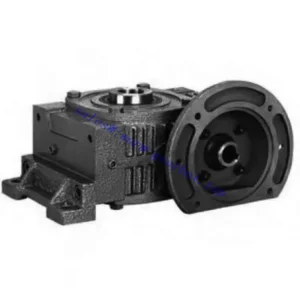
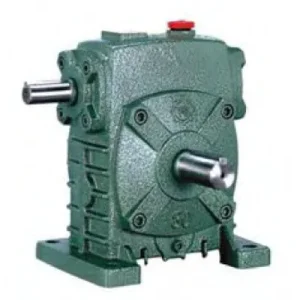
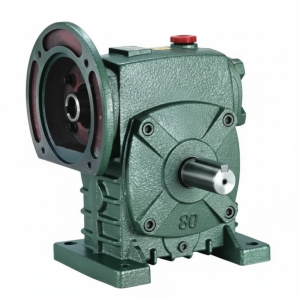
The DZ Series Worm Gear Reducer solves a specific engineering problem: delivering IEC B5 motor flange input and solid shaft output in a housing envelope that is dimensionally shorter than the WDZ or WD series at the same power rating. The DZ achieves this compact form by redesigning the body geometry — the AB combined dimension replaces the separate A and B convention of the W family, producing a housing that is more axially compact along the output shaft axis while retaining full IEC flange motor direct-coupling on the input face. No input coupling, no coupling guard, no motor bracket; the motor flanges directly and the output shaft connects to the driven load via a standard coupling or sprocket. For Australian OEM machinery builders and site engineers who need the clean IEC motor integration of a flange-mount design in a machine bay too narrow for the W-series or WD-series housing depth, the DZ provides the right answer. Sizes 50 through 135, input powers 0.18 kW to 3.0 kW, ratios 1:10 to 1:60.
Technical Specifications — DZ Series Worm Gear Reducer
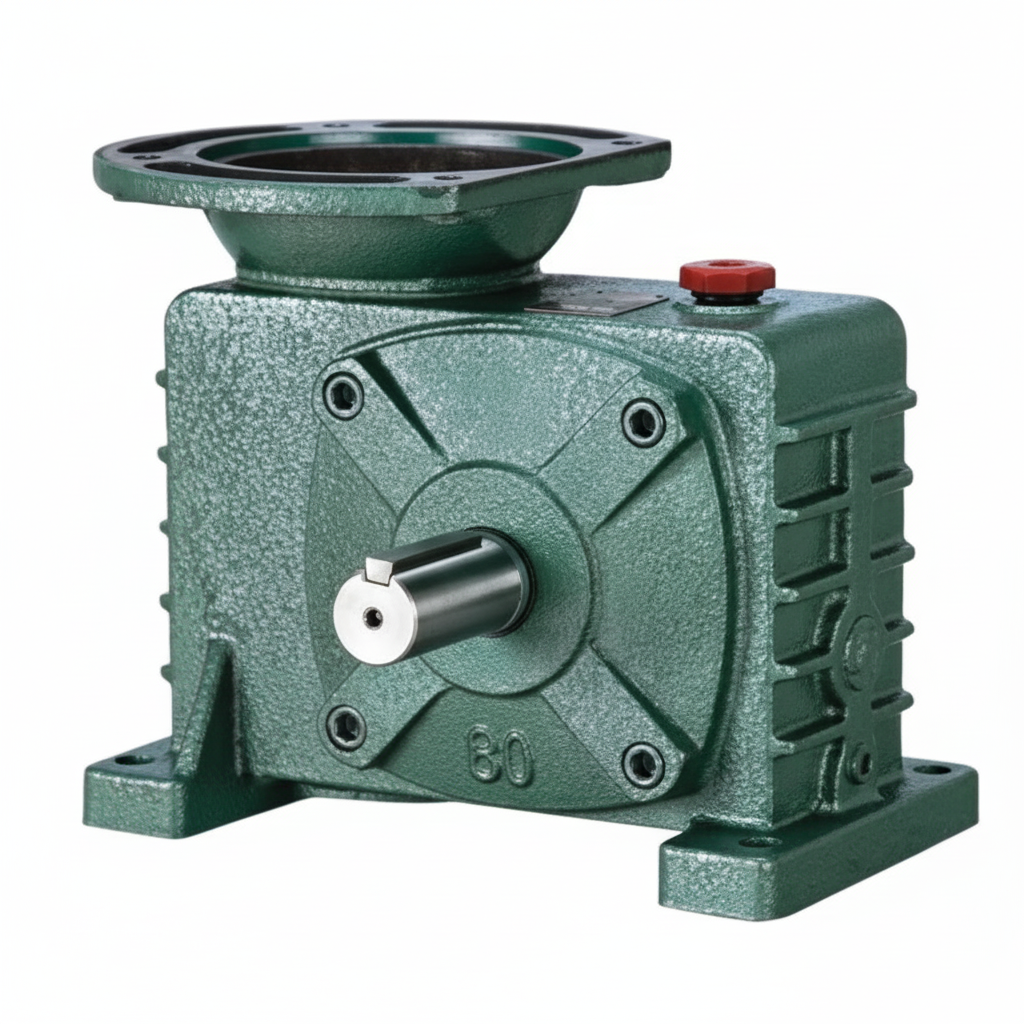
Configuration: IEC B5 Flange Input + Solid Shaft Output — Compact Housing
Motor bolts directly to IEC B5 flange — no input coupling. Solid output shaft connects to driven equipment via coupling or sprocket. Compact AB housing dimension reduces machine bay footprint versus equivalent WDZ or WD units. Sizes 50–135.
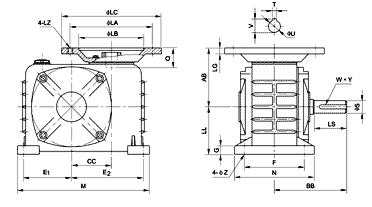
| Size | Power (kW) | Ratio | AB (mm) | LL (mm) | BB (mm) | CC (mm) | Flange LZ (mm) | Input Q (mm) | Output LS (mm) | Output S (mm) | Weight (kg) |
|---|---|---|---|---|---|---|---|---|---|---|---|
| 50 | 0.18 | 1/10–1/60 | 87 | 76 | 95 | 50 | 140 | 25 | 40 | Ø17 | 7.5 |
| 60 | 0.18/0.37 | 1/10–1/60 | 78 | 82 | 110 | 60 | 140/160 | 25/35 | 50 | Ø22 | 12 |
| 70 | 0.37/0.75 | 1/10–1/60 | 101 | 95 | 130 | 70 | 160/200 | 33/43 | 60 | Ø28 | 15 |
| 80 | 0.75/1.5 | 1/10–1/60 | 118 | 100 | 140 | 80 | 200 | 43 | 65 | Ø32 | 22 |
| 100 | 1.5/2.2 | 1/10–1/60 | 145 | 135 | 155 | 100 | 200/250 | 55/65 | 75 | Ø38 | 38 |
| 120 | 2.2/3.0 | 1/10–1/60 | 160 | 160 | 185 | 120 | 250 | 65 | 85 | Ø45 | 60 |
| 135 | 3.0 | 1/10–1/60 | 183 | 170 | 210 | 135 | 250 | 65 | 95 | Ø55 | 80 |
0.18–3.0 kW
IEC B5 Flange Input
Solid Shaft Output
Compact AB Housing
Ratio 10:1–60:1
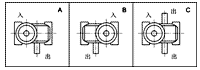
The DZ Housing Geometry — Why Compact Matters in Australian OEM Builds
The DZ departs from the W/WD/WDZ dimensional convention by using an AB combined body dimension rather than separate A (centre distance) and B (body depth) parameters. This produces a housing that is measurably more compact along the output shaft axis — relevant in three specific machine design situations:
📐 Fixed Machine Bay Width
When a machine bay has a fixed width that is insufficient for the full WDZ or WD housing depth at the same power rating, the DZ’s shorter AB dimension can fit without structural modification. This occurs in retrofits of older Australian machinery where the machine bay was designed before the W-series larger housing became standard, and in compact packaging and food-processing OEM designs where every 20 mm of housing depth is contested.
⚖️ Weight-Critical Shaft-Mount Installs
In shaft-mount configurations where the reducer and motor are suspended from the driven shaft and held by a torque arm, a lighter, more compact housing reduces the gravitational moment that the torque arm must carry. The DZ is 7.5–80 kg across its size range — at comparable power ratings, this is lighter than the WDZ equivalent, which reduces torque arm structural requirements in weight-sensitive overhead drive installations.
🔌 Motor-Direct in Tight Spaces
The IEC B5 flange eliminates the motor base and jaw coupling that the DZ-equivalent through-shaft unit would require. In constrained machine envelopes, removing the motor base depth plus the coupling body length from the drive package is often the difference between fitting into the machine envelope or not. The DZ achieves motor-direct in a shorter overall package than any W-family through-shaft alternative.
DZ Series Key Advantages for Space-Constrained Australian Applications
Compact AB Dimension — Fits Where WDZ Cannot
The DZ’s combined AB housing dimension is shorter than the WDZ B-dimension at the same size number. In constrained machine bays, packaging lines, and retrofit installations, this physical size difference determines whether the drive fits the machine without structural modification. Where the WDZ is specified and found too deep, the DZ is the first alternative to evaluate.
IEC Flange Input — No Motor Base Required
Any IEC B5 frame motor bolts directly to the DZ flange face — no custom motor bracket, no alignment jig, no jaw coupling spider to replace. Motor shaft and worm shaft are co-axial within 0.05 mm TIR. In compact OEM machine production this eliminates the motor base fabrication step and saves alignment time per unit. On remote Australian sites, any IEC B5 motor from local electrical stock drops directly onto the DZ without additional hardware.
Self-Locking at ≥ 30:1 — Power-Off Hold
At ratios 30:1 and above, the worm mesh holds the output shaft stationary on power-off without a brake. For gate actuators, slow conveyors, and positioning drives in Australian water infrastructure and food processing, this eliminates a separate braking device — particularly valuable in a compact drive where adding an external brake would defeat the space-saving benefit of specifying the DZ in the first place.
Cast Iron Housing — Sealed, Robust
The DZ housing is cast iron with sealed bearing housings and a gasket-sealed inspection cover. In food processing environments, the sealed housing presents no internal oil-contamination risk from a breached cover. In dusty outdoor Australian agricultural environments, the sealed housing prevents abrasive particle ingress that shortens bearing and gear life in open or unsealed reducers running similar duty cycles.
Phosphor-Bronze Wheel — Wear-Sacrificing Design
The centrifugally cast phosphor-bronze worm wheel runs against a case-hardened alloy steel worm. The bronze wheel is the intentional wear element — it sacrifices progressively and gives audible and visual warning before failure. Replacement parts are available independently; the worm shaft does not require replacement when the wheel reaches wear limit. This predictable failure mode is significantly easier to manage in remote Australian locations than catastrophic gear failure.
Thermal Rating — Hot Ambient Consideration
The DZ’s compact housing has proportionally less surface area for heat dissipation than a WDZ at the same power. At ratios 40:1+ in continuous duty in 40°C+ Australian summer ambient, verify the thermal rating before specifying. PAO synthetic ISO VG 220 extends the thermal ceiling by 10–15% and is recommended for continuous-duty DZ installations in northern and inland Australian environments during summer operation.
Applications — Where DZ Compactness Is the Deciding Factor
- 📦 Compact Packaging Machine Drives
DZ size 60–100 on Australian OEM packaging line metering, filling, and indexing drives where the drive bay is constrained by structural members or adjacent machine components. The IEC flange eliminates the motor base; the compact AB housing fits the bay without modification. For OEM builders producing 20–50 identical machines annually, the reduced hardware list (no motor base, no coupling guard) measurably reduces assembly time and parts inventory. - 🌾 Small Agricultural Equipment Drives (compact worm gearbox)
DZ size 50–80 for small-frame seed drills, fertiliser spreader metering drives, and compact irrigation valve actuators where the available drive space is limited by implement frame geometry. The W-series housing would not fit inside the implement structural frame at the same power rating; the DZ’s compact AB dimension fits without structural modification. Where the drive is tractor PTO-connected rather than electric-motor powered, a yoke-end IEC flange adaptor with friction slip clutch connects to the DZ flange face — refer to agricultural PTO shaft specifications for yoke and slip clutch sizing guidance. - 💧 Gate Actuators and Flow Control — Self-Locking
DZ size 80–120 at 40:1–60:1 for compact gate actuator drives in water treatment and irrigation infrastructure. The self-locking mechanism at these ratios holds the gate stationary on power-off without a brake. The compact housing fits smaller valve actuator enclosures where a WDZ or WD housing would be too deep for the actuator casing or structural mounting bracket. - 🏭 Food Processing Metering and Conveyor Drives
DZ size 60–100 on food-grade conveyor metering sections in Australian dairy, seafood, and fresh produce processing. The sealed housing prevents lubricant contamination; the IEC flange eliminates the coupling body that would otherwise require regular wash-down cleaning around the coupling gap. Motor replacement from standard IEC stock is straightforward in regional food processing plants where access to specialist drive components may involve overnight freight. - 🔄 Retrofit Upgrades — Replacing Older Compact Reducers
When older compact worm reducers in Australian machinery wear out, the DZ is frequently the correct replacement where the original machine bay cannot accommodate a full W-series or WP-series housing depth at the same power rating. Confirm LZ, LB, and Q flange dimensions against the motor IEC frame before ordering; the DZ flange is IEC standard and accommodates any B5-frame motor in the same power bracket.
Drive Accessories and Component Selection
IEC B5 Motor — Frame Verification
Before ordering: confirm motor IEC frame matches LZ and LB flange bolt circle; motor shaft diameter matches Q; motor shaft length does not exceed T×V bore depth. Record the motor IEC frame on the plant maintenance schedule — on compact DZ drives in tight machine bays, motor replacement without a pre-confirmed frame can cause multi-hour delays if the replacement motor requires fitting adjustment.
PTO Yoke Adaptor + Slip Clutch
For tractor PTO input, a yoke-end IEC flange adaptor replaces the electric motor at the DZ input face. A friction slip clutch at 1.5× rated input torque protects the DZ worm gear from tractor PTO engagement surges. The compact DZ housing is particularly relevant on small-frame implements where the larger WDZ would not fit the implement structural envelope. Refer to PTO shaft specifications for yoke sizing.
Output Shaft Coupling or Sprocket
The DZ solid output shaft (S diameter, LS length, W×Y key) connects to the driven equipment via a standard jaw coupling, chain sprocket, timing pulley, or other shaft-to-shaft connection. For smooth loads, a standard elastomeric jaw coupling is appropriate. For shock loads or cyclic reversing, a curved-jaw or disc coupling reduces peak torque transmission to the DZ gear set. Match coupling bore diameter to S and keyway to W×Y exactly.
Coupling Guard
The DZ output shaft coupling requires a guard compliant with Australian AS 4024 machinery safety standards. Unlike the hollow bore variants (where the bore-shaft connection requires no guard), the DZ solid shaft output requires a coupling guard on every installation. On compact DZ installations in tight machine bays, the coupling guard profile must be checked against adjacent structural members before finalising the drive layout.
Oil and Thermal Management
ISO VG 220 mineral oil standard fill. For ratios ≥ 40:1 in continuous duty above 35°C ambient, verify the DZ thermal rating — the compact housing has proportionally less surface area than a WDZ for the same power. PAO synthetic VG 220 extends the thermal ceiling by 10–15%. For enclosed machine installations where the DZ is surrounded by heat-generating components, consider fitting an external cooling fan or increasing service intervals to 1,500 hours.
Torque Arm (Shaft-Mount Option)
While the DZ is primarily foot-mounted, shaft-mount configuration with a torque arm is possible on the output shaft. The torque arm carries the reaction torque plus the gravitational moment of the motor-plus-reducer assembly. The compact DZ weight (7.5–80 kg) makes shaft-mount feasible at smaller sizes — at size 80 and above, use a rubber-bushed heavy-duty arm and verify combined load against the arm anchor point structural capacity.
Maintenance Schedule — DZ Series
| Interval | Task | DZ Compact-Housing Note |
|---|---|---|
| First 500 hr | Oil flush and replace; output coupling re-check; flange bolt torque | Compact housing heats more rapidly in break-in — monitor housing temperature at 100 and 250 hours; if exceeding 75°C, increase oil change interval to 250 hours until thermal behaviour stabilises |
| Every 2,500 hr | Full oil change; all seals; output coupling spider inspection | Inspect output shaft seal — the compact housing gives less seal recess depth than WDZ; seal lip hardening in high-ambient environments accelerates oil seep faster than on larger housings |
| Every 5,000 hr | Bearing radial clearance measurement; output shaft runout; worm wheel visual | Check output shaft S-end for coupling fretting — the compact LS dimension concentrates any coupling micro-slip over a shorter shaft section, making fretting more visible earlier than on longer-shaft WDZ units |
| Motor replacement | Confirm IEC frame and shaft length before ordering | DZ flange is IEC standard — any IEC B5 frame motor fits; but always confirm shaft length against T×V bore depth as manufacturers vary shaft length within the same IEC frame number |
For DZ size selection against your machine bay depth constraint, thermal rating verification in your ambient environment, and IEC motor frame compatibility confirmation, the engineering team at our worm gearbox technical portal provides application-specific support. For enquiries about compact worm gear drive solutions for Australian agricultural and industrial machinery, contact us via the technical enquiry page. For additional resources on agricultural gearbox integration in Australian conditions, visit gearboxagricultural.com.