Description
Technical Specifications — QY Series NEMA C-Face Worm Gear Reducer
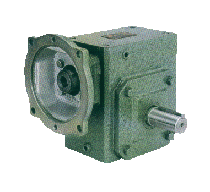
Input: NEMA C-Face Flange
Motor bolts directly to NEMA C-face — no input coupling, no motor base. Supported frames: 56C, 140TC, 180TC, 210TC. Motor shaft and worm shaft co-axial from factory. NEMA-standard pilot diameter and bolt circle.
Output: NEMA-Standard Hollow Bore
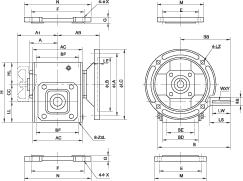
Hollow bore (S diameter, ANSI keyway W×V) seats directly on driven shaft — no output coupling. All QY dimensions in inches, NEMA-compatible. Same bore sizes as UY equivalent.
NEMA C-Face Motor Frame Coverage — QY by Size
| QY Size | 56C | 140TC | 180TC | 210TC | Output S (in) |
|---|---|---|---|---|---|
| 133 | ✓ | — | — | — | 0.625 |
| 154 | ✓ | — | — | — | 0.750 |
| 175 | ✓ | — | — | — | 0.875 |
| 206 | ✓ | — | — | — | 1.000 |
| 237 | ✓ | ✓ | — | — | 1.125 |
| 262 | ✓ | ✓ | ✓ | — | 1.125 |
| 300 | ✓ | ✓ | — | — | 1.250 |
| 325 | ✓ | ✓ | — | — | 1.375 |
| 375 | ✓ | ✓ | ✓ | — | 1.625 |
| 450 | — | ✓ | ✓ | — | 1.625 |
| 516 | — | — | ✓ | ✓ | 2.000 |
| 600 | — | — | ✓ | ✓ | 2.250 |
| Size | CC (in) | Ratio | A (in) | B (in) | H (in) | HL (in) | LL (in) | Output S (in) | Output LS (in) | Key W×V |
|---|---|---|---|---|---|---|---|---|---|---|
| 133 | 1.333 | 5–60:1 | 2.12 | 6.03 | 4.66 | 1.72 | 1.61 | 0.625 | 2.00 | 3/16×3/32 |
| 175 | 1.750 | 5–60:1 | 2.75 | 6.75 | 5.75 | 2.06 | 1.94 | 0.875 | 1.88 | 3/16×3/32 |
| 237 | 2.375 | 5–60:1 | 3.56 | 7.78 | 6.94 | 2.50 | 2.07 | 1.125 | 2.37 | 1/4×1/8 |
| 300 | 3.000 | 5–60:1 | 4.50 | 10.25 | 8.88 | 3.25 | 2.63 | 1.250 | 3.25 | 1/4×1/8 |
| 375 | 3.750 | 5–60:1 | 5.75 | 11.88 | 10.44 | 3.88 | 2.81 | 1.625 | 3.50 | 3/8×3/16 |
| 450 | 4.500 | 5–60:1 | 5.63 | 13.16 | 11.94 | 4.50 | 2.94 | 1.625 | 3.66 | 3/8×3/16 |
| 516 | 5.167 | 5–60:1 | 6.44 | 13.91 | 13.75 | 5.31 | 3.28 | 2.000 | 4.16 | 1/2×1/4 |
| 600 | 6.000 | 5–60:1 | 7.44 | 15.31 | 16.50 | 6.50 | 4.00 | 2.250 | 4.56 | 1/2×1/4 |
56C / 140TC / 180TC / 210TC
No Input Coupling
Hollow Bore Output
Self-Locking ≥30:1
5:1–60:1 All Sizes
QY vs UY — When the Input Coupling Must Go
| Feature | UY Series | QY Series |
|---|---|---|
| Input type | Through-shaft — jaw coupling | NEMA C-face — motor direct |
| Motor base required | Yes — motor sits on separate base | No — motor bolts to flange face |
| Input coupling maintenance | Spider replacement on schedule | None — coupling eliminated |
| Motor frame compatibility | Any NEMA motor via coupling | 56C, 140TC, 180TC, 210TC only |
| Output | NEMA hollow bore | NEMA hollow bore |
QY Advantages — NEMA C-Face Zero-Coupling Integration in North American Spec Machines
NEMA C-Face — No Motor Base, No Coupling
Any NEMA C-face motor (56C through 210TC, depending on QY size) bolts directly to the QY input flange — no motor base fabrication, no jaw coupling, no coupling spider to replace on a maintenance schedule. Motor shaft and worm shaft are co-axial from the factory. In North American equipment built to NEMA motor-direct specifications, the QY replaces a failed NEMA C-face worm reducer without requiring any motor base or coupling hardware procurement.
NEMA Pilot Diameter — Perfect Motor Alignment
The QY NEMA C-face includes the standard pilot bore (register) diameter that locates the motor concentrically before the flange bolts are tightened. Motor concentricity is factory-set to within NEMA tolerances — approximately 0.002–0.005″ TIR — without any alignment procedure. The jaw coupling and the misalignment it must tolerate are removed from the drivetrain entirely.
Self-Locking at ≥30:1 — Power-Off Hold
At QY ratios 30:1, 40:1, 50:1, and 60:1, the worm mesh self-locks on power-off — the hollow bore holds the driven shaft stationary without a brake. For North American-specification gate actuators, conveyor drives, and inclined material handling equipment operating in Australian plant, this self-locking matches the original design intent without requiring a separate braking device at these ratios.
Compact Motor-Direct Package — Reduced Machine Envelope
By eliminating the motor base and jaw coupling, the QY reduces the motor-plus-reducer axial length by the sum of the motor base depth plus the coupling body length. In compact North American machine designs where the motor-reducer package must fit within a defined enclosure or machine bay, the QY’s shorter overall drive package length frequently determines whether the drive fits without structural modification.
Like-for-Like Replacement — NEMA C-Face Equipment
North American machinery built around NEMA C-face worm reducers from Dodge, Rexnord, Boston Gear, TB Wood’s, and similar manufacturers uses the same NEMA C-face pilot diameter and bolt circle convention. The QY cross-references directly to these units at matching size and ratio — same CC dimension, same NEMA flange, same output bore. Replacing the QY in the machine requires no re-engineering of the motor or driven shaft connection.
Motor Frame Must Match — Confirm Before Ordering
The QY NEMA C-face accepts only the specific NEMA frames listed for each size (56C, 140TC, 180TC, 210TC per the table above). A 182TC frame motor does not fit a 180TC QY — “TC” frame means inline pilot bore (threaded holes for C-face mount, pilot bore within tolerance). Confirm the motor’s NEMA frame designation against the QY size’s available frame list before ordering. Submitting the motor nameplate frame designation to the technical team before placement avoids frame mismatches on Australian sites where motor frame return and replacement carries significant logistics cost.
Applications — QY in Australian Operations and NEMA Export Markets
- ⛏️ North American Mining Equipment — NEMA C-Face Reducer Replacement (low speed worm gearbox)
QY size 262–600 (140TC–210TC frames) for Australian mining operations running North American shuttle car pump drives, feeder breaker conveyors, and surface mining equipment where the original NEMA C-face worm reducer has failed. The QY at matching CC size and ratio replaces the failed unit without motor modification — the existing NEMA C-face motor re-attaches directly. Sourcing from Australia eliminates the North American lead time and international freight delay. - 🏭 North American Food and Packaging Lines — Motor-Direct Hygiene Advantage
QY size 133–300 (56C–140TC) for Australian food processing lines running North American-specification equipment. The NEMA C-face motor-direct connection eliminates the jaw coupling body from the drive — in wash-down environments, eliminating the coupling gap removes a bacterial harbourage point and reduces cleaning cycle time. Self-locking at 30:1 and above holds conveyor position stationary during product clearing without a separate brake. - 🌾 Agricultural Equipment — NEMA C-Face Metering and Auger Drives
QY size 133–262 (56C–180TC) for North American grain auger drives, seed metering mechanisms, and fertiliser spreader drives in Australian agricultural equipment. Motor removal and replacement uses the standard NEMA C-face dismount procedure — the motor disconnects from the QY flange without removing the reducer from the driven shaft. For agricultural applications also using tractor PTO, a PTO adaptor at the hollow bore output face allows direct implement drive from PTO when electric motor power is unavailable. Further PTO integration detail at agricultural PTO shaft resources. - 🏗️ OEM Builds for North American Export — NEMA-Native Specification
QY size 133–600 for Australian OEM machine builders producing equipment for Canadian and American markets where NEMA C-face motor-direct worm reducers are the expected industry standard. Specifying the QY from the Australian factory provides a NEMA-native drive package that destination-market customers can service with locally available NEMA-specification motors and parts — without IEC-to-NEMA conversion hardware. For additional gearbox engineering guidance applicable to both Australian and export-market agricultural and industrial drives, refer to gearboxagricultural.com. - 💧 Water Infrastructure — NEMA-Specified Gate and Pump Drives
QY size 262–450 (140TC–180TC) at 30:1–60:1 for Australian irrigation and water treatment infrastructure originally designed to NEMA standards in the 1990s–2000s, now requiring like-for-like reducer replacement with NEMA C-face input. The self-locking at these ratios holds gates stationary on power-off without a separate brake — the same behaviour as the original NEMA C-face unit. Replacement requires only motor de-coupling and re-coupling, with no machine structural work.
Drive Accessories and Component Selection for the QY
NEMA C-Face Motor — Frame Verification First
Before ordering: confirm the motor’s exact NEMA TC or C frame designation against the QY size’s available frame list. 56C, 56HC, 143TC, 145TC, 182TC, 184TC, 213TC, 215TC are the most common NEMA frames — map these to the QY size table. A motor described as “1-1/2 HP NEMA 56C” fits QY sizes 133–375; a “5 HP 184TC” fits QY 262–375 only in the 180TC column.
NEMA C-Face Mounting Hardware
The QY NEMA C-face uses NEMA-standard bolt circle diameter and pilot bore. Motor mounting bolts follow NEMA-standard UNC thread — do not substitute metric screws. For Australian field replacement, source NEMA UNC stainless steel hex cap screws (preferred for corrosion resistance in outdoor installations) before beginning the replacement to avoid work stoppage when metric fasteners from site stock do not fit the NEMA thread pattern.
Oil — AGMA 8 or ISO VG 220 Synthetic
Same specification as UY — AGMA 8 mineral (= ISO VG 220 mineral) for standard service; AGMA 8S synthetic (= ISO VG 220 PAO) for continuous duty above 35°C Australian ambient. The QY thermal rating was developed at AGMA 25°C reference ambient — at 40°C+ Australian summer, verify the thermal rating at your duty cycle before finalising ratio and size for continuous-duty applications at ratios ≥30:1.
Horizontal Base (Optional)
Like the UY, a horizontal mounting base is available for the QY for foot-mount floor or frame installation. Specify at order. For shaft-mount operation without the base, the QY requires a torque arm at the housing to carry the reaction torque and the gravitational moment of the motor-plus-reducer weight. The motor bolted to the QY NEMA C-face adds motor weight to the arm calculation — include motor weight in the torque arm specification.
Output Hollow Bore — ANSI Key and Shrink Disc
QY output hollow bore uses ANSI-standard keyway (W×V in fractional inch). For smooth conveyor loads at small sizes, a set screw is acceptable. For sizes 300 and above at sustained high torque, a shrink disc is recommended — ANSI keyways at these bore sizes provide shorter key engagement length relative to torque than WA-class metric bores, making fretting more likely under cyclic or shock torque if only set-screw secured.
Cross-Reference — Major North American Brands
The QY cross-references directly to NEMA C-face worm reducers from Dodge (Boston Gear), Rexnord, TB Wood’s, Dayton, and Leeson at matching size and ratio. Record the original unit’s CC size, ratio, and NEMA frame from the nameplate before contacting the technical team — three data points are sufficient for a confirmed QY cross-reference without requiring the original unit to be shipped for physical measurement.
Maintenance Schedule — QY Series (Australian Operating Conditions)
| Interval | Task | QY NEMA C-Face Note |
|---|---|---|
| First 500 hr | Oil flush; NEMA flange bolt torque re-check; output bore set screw or shrink disc | Inspect NEMA C-face pilot bore gap for oil weep — if housing oil migrates to the flange face, it can contaminate the motor shaft seal; clean and seal with NEMA-appropriate gasket sealant if weep is observed |
| 2,500 hr | Oil change; all seals; NEMA flange bolt re-torque; output keyway fretting check | Remove motor at each full service and inspect the NEMA pilot bore register for fretting — motor weight concentrated at the flange face causes pilot bore fretting in vibrating applications over time; apply anti-galling compound at reassembly |
| Motor replacement | Confirm NEMA frame matches QY size before sourcing replacement motor | Record motor NEMA frame on plant maintenance record at installation — on remote Australian sites, confirming frame before sourcing avoids a second freight consignment if the replacement motor frame does not match the QY flange |
For QY NEMA frame cross-reference against your motor nameplate, thermal rating verification at Australian ambient, output bore shrink disc specification for large sizes, and Australian stocking status for your required CC size, ratio, and NEMA frame combination, contact the engineering team at our worm gearbox technical portal. Submit your original reducer nameplate (CC size, ratio, NEMA frame) and motor nameplate frame designation for a confirmed QY cross-reference. Reach us via the technical enquiry page.