Description
Technical Specifications — EDO Series Double Worm Gear Reducer
⚠️ Critical: Rated Output Torque Is the Combined Total Across Both Bores
Both EDO output bores share one worm wheel. If each driven shaft requires T (Nm), select an EDO stage pair rated for 2T combined output torque at the chosen ratio. Treating the rated torque as a per-bore figure when both bores are simultaneously loaded results in 2× overload on the second-stage worm wheel.
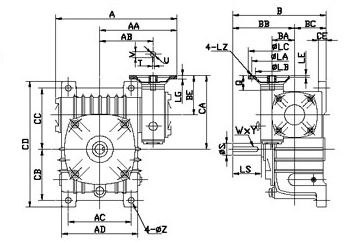
| Stage Pair | Power (kW) | Ratio | A (mm) | B (mm) | BB (mm) | CC/E1/E2 (mm) | Flange LZ (mm) | Input Q (mm) | Output LS (mm) | Output S (mm) | Key W×Y |
|---|---|---|---|---|---|---|---|---|---|---|---|
| 50–80 | 0.18 | 200–900 | 314 | 210 | 140 | 70/84 | 140 | 25 | 65 | Ø32 × 2 | 10×4.5 |
| 60–100 | 0.37 | 200–900 | 363 | 245 | 155 | 90/92 | 160 | 35 | 75 | Ø38 × 2 | 10×4.5 |
| 70–120 | 0.37/0.75 | 200–900 | 429 | 285 | 185 | 100/110 | 160/200 | 35/45 | 85 | Ø45 × 2 | 12×4.5 |
| 80–135 | 0.75/1.5 | 200–900 | 505 | 320 | 210 | 110/128 | 200 | 45 | 95 | Ø55 × 2 | 15×5 |
| 100–155 | 1.5 | 200–900 | 565 | 392 | 252 | 140/145 | 200 | 55 | 110 | Ø60 × 2 | 15×5 |
| 120–175 | 2.2/3.0 | 200–900 | 635 | 412 | 262 | 150/182 | 250 | 65 | 110 | Ø65 × 2 | 18×6 |
| 135–200 | 3.0 | 200–900 | 691 | 480 | 305 | 175/200 | 250 | 65 | 125 | Ø70 × 2 | 20×7 |
200:1–900:1
IEC B5 Flange Input
Dual Co-Axial Hollow Bores
Double Self-Locking
Stage Pairs to 135-200
The EDO’s Position — Maximum Integration in the E-Series Family
| E-Series Unit | Input | Output | Max Ratio | Couplings |
|---|---|---|---|---|
| EA (FCEA) | Through-shaft / IEC flange | Solid shaft — 1 face | 900:1 | 1 (output) or 0 if FCEA |
| EO | Through-shaft (both sides) | Solid shaft — 2 faces | 900:1 | 1–2 (output, per face) |
| EDA | IEC B5 flange | Hollow bore — 1 face | 900:1 | 0 — shaft mount direct |
| EDO ← This Unit | IEC B5 flange | Dual hollow bore — 2 faces | 900:1 | 0 — three-end direct |
The EDO is the logical endpoint of the E-series integration axis: where the EA requires at least one coupling somewhere in the drivetrain, and the EDA achieves zero couplings for single-output drives, the EDO achieves zero couplings across all three connection points of a dual-output ultra-high-ratio drive. For applications where this combination is the engineering requirement, no other single catalogue unit delivers it.
EDO Advantages — The Complete Integration Case at Ultra-High Ratio
Three-End Zero Couplings at 200–900:1
IEC motor bolts to input flange — no input coupling. Each driven shaft slides into its respective hollow bore — no output couplings. Three connection points, zero coupling bodies, zero coupling guards, zero alignment steps. At ultra-high ratios where the driven equipment often operates in constrained environments (actuator housings, sealed enclosures, gas-tight digester heads), eliminating all coupling bodies from the installation envelope simplifies both the mechanical design and safety compliance.
Exact Co-Axial Synchronisation — Ultra-Low Output Speed
Both bores share one worm wheel — the speed ratio between them is exactly 1:1, permanent, with no chain stretch, no sprocket wear, no phase accumulation over time. At 1.6–7.25 rpm output (200:1–900:1), any timing error between two co-axial shafts becomes immediately visible as physical misalignment in the driven mechanism. The EDO makes this error physically impossible by sharing one wheel between both bores.
Double Self-Locking — Both Bores Held on Power-Off
Both worm stages self-lock simultaneously. Both driven shafts are locked against back-drive from either bore on power-off — without any external brake or latch. For gate valve twin-stem mechanisms where both stems must hold simultaneously against flow pressure, or for contra-rotating agitators that must stop simultaneously and stay stopped during maintenance access, this double self-locking delivered through both bores simultaneously provides positive mechanical hold at both outputs.
Replaces Two EDA Units + Synchronisation Shaft
Achieving co-axial twin slow-speed shaft-mount drives with EDA units requires two complete EDA units plus an inter-shaft synchronisation mechanism. The EDO replaces this entire assembly: two EDA housings, two second-stage synchronisation gear elements, two inter-unit couplings, and the associated alignment and maintenance for all of these — condensed into one housing, one oil fill, one maintenance service point.
One Motor + One VFD Controls Both Output Shafts
Both EDO output bores change speed proportionally when the VFD frequency changes — the 1:1 speed ratio between them is preserved at all VFD frequencies. Two separate EDA units with two VFDs require synchronisation programming and still have algorithm-dependent timing accuracy. The EDO provides hardware-guaranteed synchronisation that cannot be disrupted by control system logic, communication delay, or VFD parameter drift.
135-200 Stage Pair — Extreme Torque at Dual Output
The EDO 135-200 at 900:1 with 3.0 kW input delivers a combined theoretical output torque exceeding 8,000 Nm distributed across both bores simultaneously. At combined torque of this magnitude from a 3.0 kW motor, the EDO exceeds what any hydraulic actuator at equivalent power input can typically achieve — and does so with mechanical self-locking, not hydraulic pressure, to hold position.
Applications — Ultra-High Ratio Co-Axial Twin-Shaft Drives in Australian Plant
- 🌊 Twin-Stem Gate Valve and Penstock Mechanisms
EDO 80-135 to 120-175 at 400:1–600:1, with both bore faces driving co-axial gate valve stems simultaneously. Both stems receive exactly matched force — no differential stem advance that would cause the gate to rack or jam. IEC motor bolts direct to the input flange. Both stems self-lock on power-off simultaneously. In large diameter Australian water infrastructure penstocks where twin-stem valve mechanisms are the standard for gates above 500 mm diameter, the EDO is the most compact and reliable zero-coupling twin-stem actuator available. - 🧪 Contra-Rotating Agitator Drives — Gas-Tight Digester Heads
EDO 60-100 to 100-155 at 300:1–500:1 for biogas and anaerobic digestion vessels where contra-rotating impellers on co-axial shafts entering from opposite ends of the vessel provide superior mixing without directional flow bias. Both impeller shafts seat in their respective EDO bores; the IEC motor and the EDO housing mount on the vessel lid. The zero-coupling configuration eliminates all coupling bodies from the gas-tight lid penetration, minimising potential gas ingress points to the bore seals only. - 🌾 Precision Twin-Feed Agricultural Implements
EDO 50-80 to 70-120 at 200:1–400:1 for precision planting implements where two co-axial metering shafts must rotate at exactly matched ultra-low speed to deliver uniform bilateral seed or fertiliser placement. The IEC flange input allows direct connection to a tractor-mounted electric drive or a compact BLDC motor; the dual hollow bore outputs shaft-mount directly onto the implement’s bilateral metering rollers. For PTO-input variants, refer to agricultural PTO shaft integration resources. - ☀️ Solar Tracker Dual-Axis Bilateral Panel Arrays
EDO 60-100 to 80-135 at 500:1–800:1 for bilateral solar tracker arrays where one EDO is centrally mounted, driving the left and right panel frame sections from its two output bores simultaneously. Both panel sections receive exactly matched rotation; wind-induced frame flex that would cause differential rotation in a chain-synchronised pair creates no differential torque on the EDO’s worm wheel — both sides present the combined torque as a single load. Self-locking holds both panel frames at the tracking angle throughout the night without any latch or brake. - 🏭 Co-Axial Positioning Drives — Industrial Automation
EDO 70-120 at 400:1–600:1 for OEM industrial positioning mechanisms where a central driven axis must be actuated from both ends simultaneously without torsional wind-up differential between the two driving points. Injection moulding clamp mechanisms, precision press ram drives, and large-format motion table screw drives where co-axial twin-input is required for uniform load distribution across the driven axis are all applications where the EDO provides the required twin-input ultra-low-speed drive without a secondary synchronisation mechanism. For further guidance on industrial gearbox solutions in Australian automation, visit gearboxagricultural.com.
Drive Accessories and Component Selection for the EDO
Motor Power — Combined Bore Load Required
Motor power must cover the combined torque from both bores: P_input = (T₁ + T₂) / (ratio × η). This is a strict requirement — using single-bore torque for motor sizing results in motor thermal overload during normal combined operation. Small IEC motors at large EDO stage pairs produce very large combined output torques; confirm the motor thermal rating is adequate for the calculated combined input power.
Dual Shrink Discs — Both Bores
Both bores require individual shrink discs for all EDO stage pairs 70-120 and above, where output torques per bore can exceed 1,000 Nm even at moderate power inputs. Torque both shrink discs in cross-pattern sequence simultaneously to maintain symmetric clamping pressure on both bore faces. Asymmetric clamping (one disc fully torqued before the other) can generate lateral force on the worm wheel that affects bearing pre-load.
Torque Arm — Combined Reaction + Weight
The EDO torque arm must resist the combined reaction torque (T₁ + T₂) plus the gravitational moment of the motor-plus-reducer assembly. For large stage pairs (135-200 with motor), total assembly weight may exceed 120–160 kg — the gravitational moment at typical arm lengths (300–500 mm) can exceed the reaction torque in the arm anchor force calculation. Always include gravitational moment in the arm specification.
PAO Synthetic Oil — Continuous-Duty Thermal
Two separate oil fills (one per stage). Both stages require PAO synthetic ISO VG 220 for continuous-duty EDO installations at ratios ≥ 400:1 in 40°C+ Australian ambient. The combined load from both bores increases first-stage heat generation compared to an equivalent single-bore EDA — thermal rating must be verified at the combined power level, not single-bore.
Temperature Sensor — Large Stage Pairs
For EDO 100-155 and 135-200 in continuous duty, a PT100 on the second stage housing provides early warning of thermal overload before bronze wheel failure. At large stage pairs, thermal failure in the EDO affects both output drives simultaneously — repair cost and downtime impact is double that of an equivalent EDA unit. Monitoring is proportionally more valuable on the EDO than on any single-bore equivalent.
Oil Orientation — Both Stages, Both Bore Orientations
The EDO has both bores on the co-axial output axis. In vertical bore orientation (bore axis vertical, both shafts vertical), the second-stage oil level must be verified for this orientation independently of the first stage. Submit your complete installation orientation drawing to the technical team before commissioning — oil starvation in the second stage under vertical bore orientation is a common EDO failure in gate valve and vertical digester shaft applications.
Maintenance Schedule — EDO Series
| Interval | Task | EDO Dual-Bore Note |
|---|---|---|
| First 500 hr | Flush both stages; both shrink discs cross re-torque; flange bolt check | Inspect both bore faces for fretting symmetry — asymmetric fretting between bore 1 and bore 2 indicates unequal shrink disc clamping; re-torque the weaker disc before continuing |
| 2,500 hr | Oil change both stages; all seals; both shrink discs; flange face gasket | Four shaft penetrations (two bores + IEC flange bore) — inspect all four seal faces for oil weep at each service; the EDO has more seal perimeter than any single-bore E-series unit |
| 5,000 hr | Remove both bores; bore zone inspection; inter-stage bearing; both bore seals | Compare bore diameter at both faces — differential wear between the two bores indicates unequal loading history; investigate root cause before reassembly to prevent premature repeat failure |
| If one bore jams | Full second-stage inspection before return to service; inspect both bores | Full motor torque concentrates at the jammed bore until protection trips — inspect both bore zones and the second-stage worm wheel bronze surface before returning either bore to service |
For EDO combined torque calculations, stage pair selection for your specific twin-shaft load profile, shrink disc pairing for dual bores, thermal rating assessment at combined combined bore load and Australian ambient temperature, and oil orientation guidance for vertical bore installations, the engineering team at our worm gearbox technical portal provides full application-specific support. Contact us via the technical enquiry page with your two driven shaft diameters, per-shaft torque requirements, ratio requirement, and ambient temperature.